
The Champagne Glass Guide: Types, Shapes, and How to Serve
The complete champagne glass guide. Compare flutes, coupes, and tulips, learn proper pouring and serving, and choose the right glass for every occasion.
13 expert articles, one definitive guideThere are three main types of champagne glasses: the flute, which preserves bubbles and chill; the coupe, a wide vintage shape suited to cocktails and toasts; and the tulip, which balances carbonation with aroma. For most drinkers, a fine crystal flute or tulip is the best all-purpose choice.
A glass of champagne is a small piece of engineering. The mousse that streams up from the base, the aromas of brioche and citrus that gather at the rim, the temperature that holds for the length of a toast — all of it depends on the vessel as much as the wine. Pour a grower champagne into a thick-walled tumbler and you lose half of what the winemaker spent years building. Pour it into the right crystal and the wine performs exactly as intended.
This guide covers the full landscape of champagne glasses: the three classic shapes and how they differ, the history behind them, the serving fundamentals that protect carbonation, the etiquette that matters at formal tables, and the right glass for weddings, brunches, and New Year's Eve. It also addresses the questions that come up constantly in our customer conversations — whether a coupe is ever the correct choice, how many glasses a bottle actually pours, and whether Prosecco belongs in a flute at all. Each section links to a deeper article when you want the full treatment of a single topic.
Throughout, we draw on what we know from the workshop. Luxrify's champagne glasses are hand-blown crystal, which is not a cosmetic detail — a hand-finished bowl is thinner at the lip, lighter in the hand, and shaped to keep a wine's bead alive far longer than pressed glass. We will be specific about temperatures, pour angles, and bottle counts rather than vague about ambience, because the difference between a good glass of champagne and a flat, lukewarm one comes down to a handful of concrete decisions. Once you understand why each shape exists, choosing becomes simple.
The Three Shapes: Flute, Coupe, and Tulip
Every champagne glass on the market descends from three archetypes. The flute is tall and narrow, with a small surface area that slows the escape of carbon dioxide — a properly poured flute will hold a visible bead for twenty minutes or more. The coupe is its opposite: a broad, shallow bowl that exposes the wine to air, sacrificing bubbles for an unmistakable silhouette and an easy, generous sip. The tulip splits the difference, widening at the mid-bowl to give aromas room to develop, then tapering at the rim to concentrate them and protect the mousse. Sommeliers increasingly reach for the tulip with vintage and prestige cuvées, because mature champagne is as much about scent as sparkle.
Shape is not the only variable. Bowl depth determines how long a pour stays cold, stem length keeps hand warmth off the wine, and a laser-etched or naturally imperfect point at the base of a hand-blown bowl gives bubbles a nucleation site to stream from. Wall thickness matters too: a thin, hand-finished rim delivers the wine cleanly to the palate, where a thick pressed-glass lip interrupts it. The histories behind these forms are genuinely good stories — the flute's rise from Roman glass to Art Deco icon, and the coupe's tangle of royal myth and Jazz Age glamour — and they explain why both shapes survive on modern tables. If you buy only one set, our advice is unambiguous: choose a crystal flute or tulip for the wine, and add coupes later for cocktails and ceremony.
Champagne Flute vs Coupe vs Tulip: Which Glass Is Best?
The definitive shape comparison, with guidance on which glass suits which wine.
Read the articleThe Fascinating History of the Champagne Flute
How the flute evolved over centuries into the default celebration glass.
Read the articleThe Vintage Champagne Coupe: Romance, Myth, and History
The Marie Antoinette myth, Art Deco revival, and the coupe's true story.
Read the articleKnow Your Bubbles: Champagne, Prosecco, and Other Sparkling Wines
The glass you choose should answer a prior question: what is actually in the bottle? Champagne is sparkling wine from the Champagne region of France, made by the traditional method, in which a second fermentation in the bottle creates fine, persistent bubbles and the yeasty, toasted-bread character the region is famous for. Prosecco, from northern Italy, gets its sparkle from tank fermentation, which produces softer carbonation and a fruit-forward profile of pear, melon, and white flowers. Cava, crémant, and American sparkling wines each sit somewhere along that spectrum — Cava is traditional-method and earthy, crémant is traditional-method outside Champagne, and the best California sparklers are made exactly like champagne by French-owned houses. None of these is a lesser version of another; they are different wines that reward different handling.
Practically, that means a tight flute flatters an aggressive, fine-beaded champagne, while Prosecco's gentler fizz and aromatic fruit often show better in a slightly wider tulip or even a small white-wine glass, where the orchard-fruit aromas have room to open. If your house pour is Italian, it is worth choosing stemware for it deliberately rather than defaulting to whatever came with the champagne. Knowing the production difference also makes you a sharper buyer — you will stop paying champagne prices for tank-method wine and start matching the bottle, the glass, and the occasion.
Serving Fundamentals: Temperature, Pouring, and Portions
Most champagne is ruined before it reaches the glass. Serve it too warm and the carbonation turns coarse and foamy; serve it straight from a deep freeze and the aromatics shut down completely. The working target is 45 to 48 degrees Fahrenheit for non-vintage wines, a few degrees warmer for vintage bottles with more to say. Twenty minutes in an ice-water bath gets you there faster and more evenly than hours in the refrigerator. The pour matters just as much: tilt the glass to roughly 45 degrees and let the wine slide down the inside wall, exactly as you would pour a beer. Studies of dissolved CO2 confirm what every cellar master knows — a beer-style pour preserves measurably more carbonation than dumping wine into an upright glass.
Then there is the arithmetic of hosting. A standard 750 ml bottle holds just over 25 ounces, which yields six 4-ounce flute pours, or five with a more generous hand. For a wedding toast, where guests need only two or three sips, you can stretch a bottle to eight pours. Planning a party means multiplying honestly: one bottle per two guests for a toast-only event, one bottle per guest for an evening where champagne is the main pour. Never chill the glasses themselves with ice — water residue murders the mousse. A clean, dry, room-temperature glass is the correct starting point every time.
Champagne Serving Temperature: The Perfect Chill
The exact temperature targets and fastest reliable chilling methods.
Read the articleHow to Pour Champagne Correctly Without Losing Bubbles
Angle, speed, and glass prep to keep every bubble in the wine.
Read the articleHow Many Glasses in a Bottle of Champagne? The Math
Serving math for dinners, parties, and large events.
Read the articleEtiquette: Holding, Toasting, and Formal Occasions
Champagne etiquette exists for physical reasons before social ones. You hold a flute by the stem — thumb and first two fingers, roughly where the stem meets the base of the bowl — because a palm wrapped around the bowl warms a 4-ounce pour several degrees in under a minute, flattening the wine you just chilled so carefully. The same logic governs the coupe, which is even quicker to warm and easier to spill; hold it low on the stem and resist the temptation to cradle it. From there the conventions follow: keep the glass at heart height during a toast rather than thrust overhead, make eye contact as you raise it, and touch rims gently if you clink at all — fine crystal is strongest at the bowl's curve and most fragile at the lip. At a seated dinner, your champagne glass sits to the right, above the knife, outermost in the lineup because it is poured first.
None of this is about performing refinement. It is about being the person at the wedding or the board dinner who is visibly comfortable, whose glass stays cold, and who never sends a hairline crack through a host's heirloom coupe. A few conventions are worth committing to memory: stand for formal toasts unless you are the one being toasted, never refill your own glass at a hosted table before offering to others, and cover the rim briefly with your fingers — never invert the glass — to decline a refill. The full etiquette playbook, from receiving a pour gracefully to giving a toast that lands, takes ten minutes to learn and lasts a lifetime.
Glasses for the Occasion: Weddings, Brunch, Cocktails, and New Year's Eve
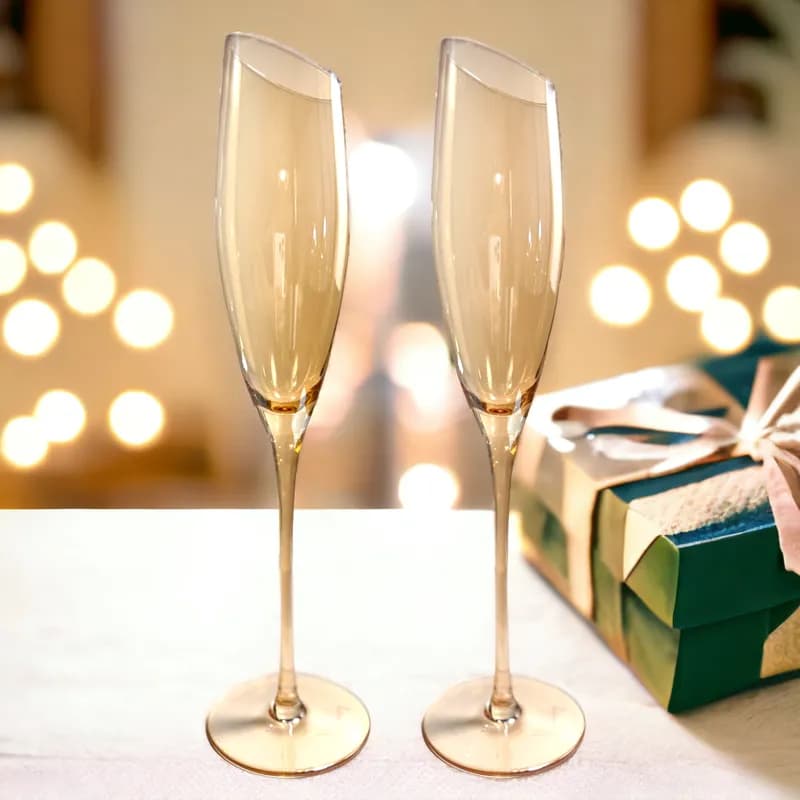
Occasions change the calculus. A wedding asks the most of a champagne glass: it must photograph beautifully in the toast, survive being held for forty minutes, and often serve as a keepsake afterward — which is why couples gravitate toward hand-blown flutes with real presence, like our iridescent and amber crystal pairs. The toasting flutes for the couple deserve particular thought, since they will appear in every photograph and, in many families, in every anniversary after. Brunch pulls the other direction entirely. A mimosa is mostly juice, served casually and refilled often, so a slightly wider bowl or even a sturdy coupe is the more practical and more pleasant choice than a delicate ceremonial flute, and stemless options earn their place on a crowded patio table.
Champagne cocktails — the French 75, the classic Champagne Cocktail with its bitters-soaked sugar cube, the Kir Royale — were born in the coupe era and still look correct in one, though a flute keeps a French 75 lively longer. And New Year's Eve is its own discipline: dozens of pours in a compressed midnight window, which rewards having enough matched glasses lined up and pre-positioned, bottles staged in ice baths an hour ahead, a designated pourer or two, and the serving math from the previous section done well in advance rather than negotiated at 11:55. The linked guides below cover each occasion in detail, from bottle selection to the moment the clock strikes.
Best Champagne Glasses for Weddings and Toasts
Toasting flutes and keepsake crystal for weddings and bridal events.
Read the articleBest Mimosa Glasses for Brunch: Flutes, Coupes, and More
Flutes versus coupes versus stemless for relaxed brunch service.
Read the article5 Elegant Champagne Cocktails You Can Make at Home
Five classic champagne cocktails, with the right glass for each.
Read the articleNew Year's Eve Champagne Guide: Glasses, Bottles, and Tips
Glasses, bottles, and timing for a flawless midnight toast.
Read the articleThe Glasses Behind This Guide
Hand-blown by Luxrify artisans. Lead-free crystal. Free US shipping on $100+.

Frequently Asked Questions
What is the best type of champagne glass?
For everyday drinking, a fine crystal flute or tulip is best because the narrow opening preserves carbonation and concentrates aroma. Tulips suit vintage and aromatic champagnes, flutes suit crisp non-vintage wines, and coupes work best for champagne cocktails and short ceremonial toasts.
Why are champagne glasses tall and narrow?
The narrow bowl minimizes the surface area where carbon dioxide escapes, so bubbles last far longer than in a wide glass. The height also gives the bead room to travel, releasing aroma as it rises, while the long stem keeps hand warmth away from the chilled wine.
Is it okay to drink champagne from a coupe?
Yes, with eyes open. A coupe loses carbonation faster and warms sooner than a flute, but it is the traditional glass for champagne towers, vintage-style toasts, and cocktails. If the moment matters more than the mousse, the coupe remains a beautiful and historically correct choice.
How full should you pour a champagne glass?
Fill a flute about two-thirds full, roughly 4 ounces, in two passes so the foam settles between pours. Leaving headspace lets the aromas collect above the wine and keeps the glass manageable. A coupe should be filled only about half to two-thirds to avoid spills.
Should champagne glasses be chilled before serving?
No. Ice or refrigerator chilling leaves water residue and condensation that disrupt the mousse and dilute the first pour. Use a clean, dry, room-temperature glass and chill the bottle properly instead, ideally in an ice-water bath to 45 to 48 degrees Fahrenheit.