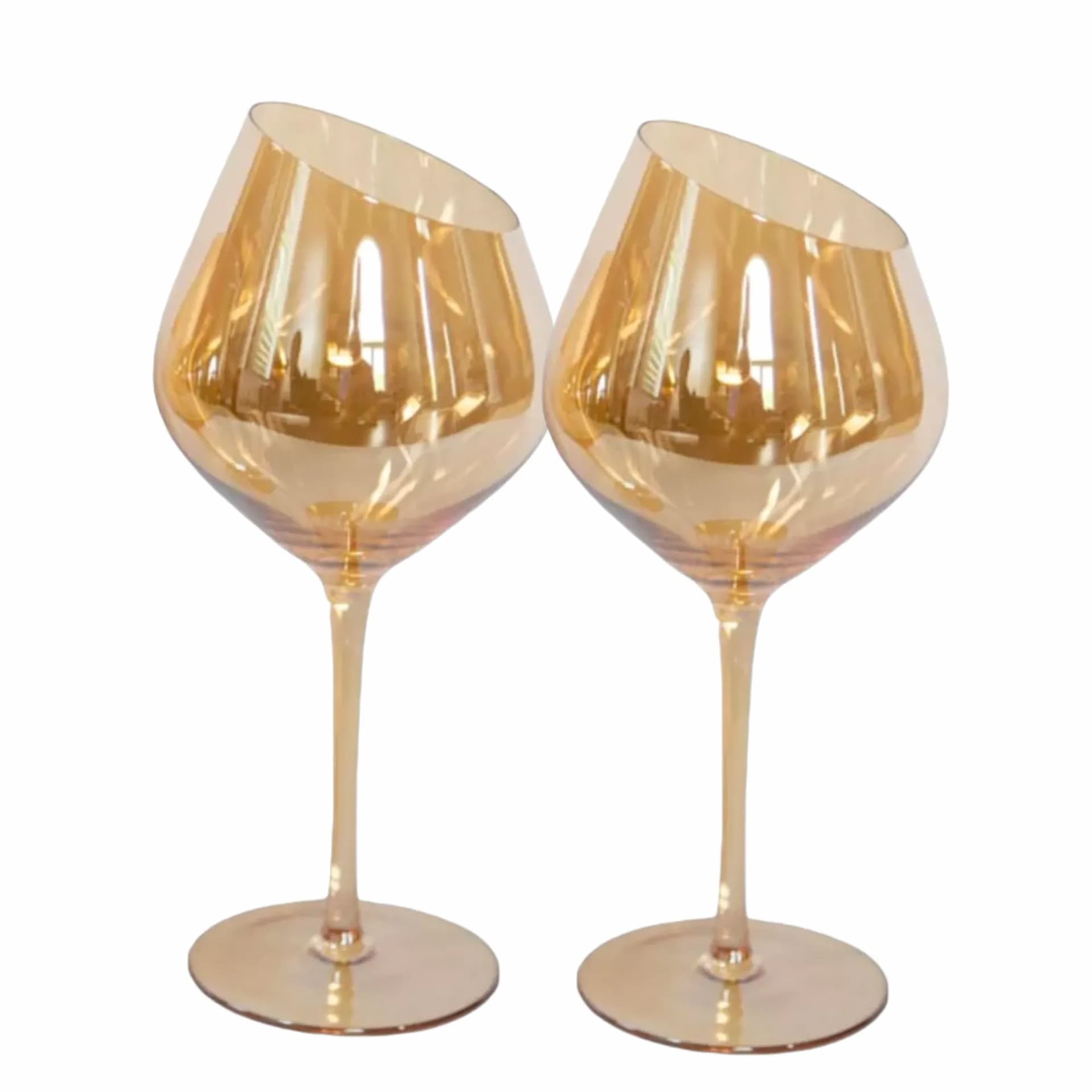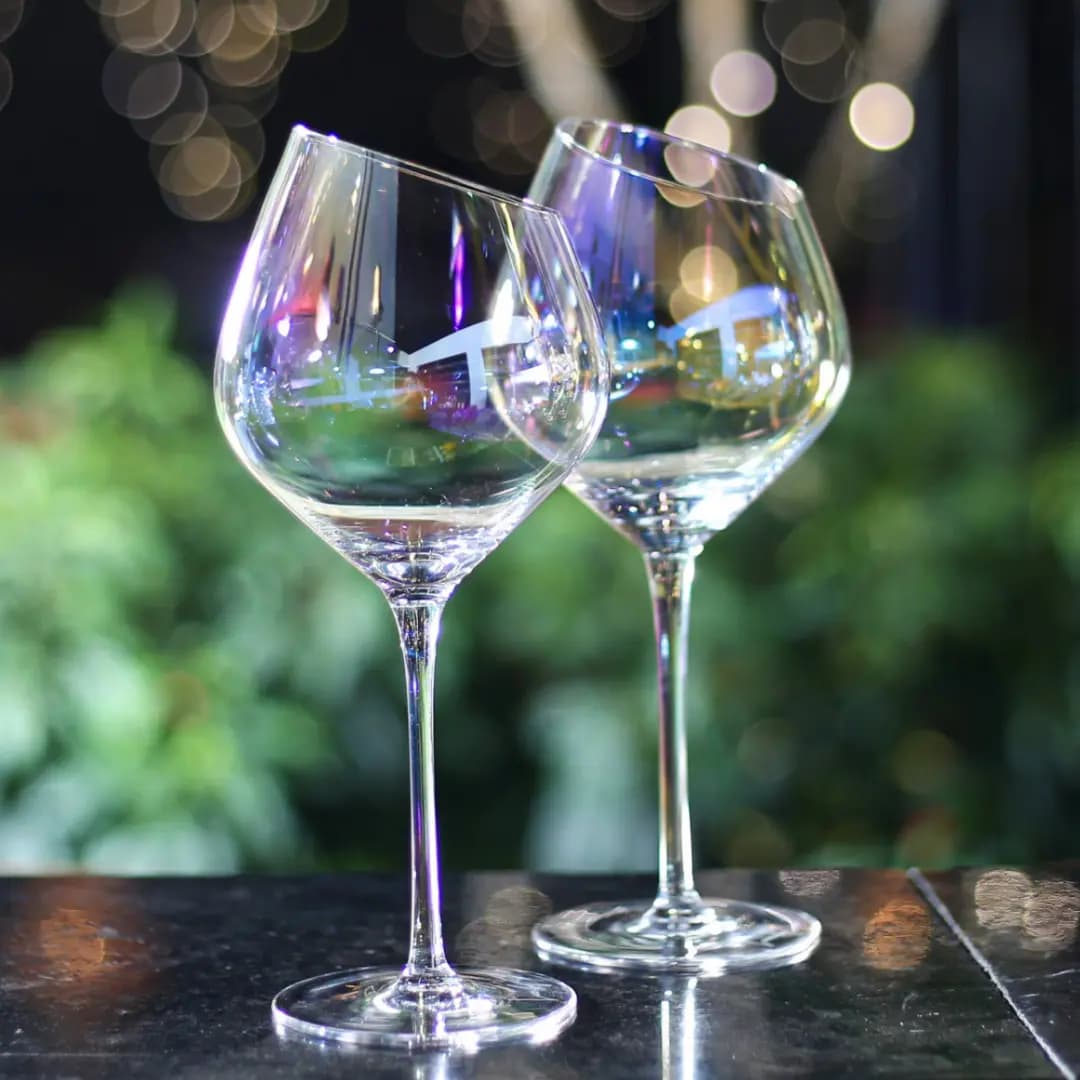
The first time you tilt an iridescent wine glass into late-afternoon light, something happens that is hard to put into words. The bowl seems to gather every hue in the room — pearl, rose, lavender, a flicker of green where the sun catches the curve — and a glass of pale Provençal rosé suddenly looks like it was poured from a soap bubble. It is the kind of effect that makes guests pick up their glass before they take a sip, just to turn it in their hands.
Iridescent wine glasses are having a genuine moment, and not only because they photograph beautifully. The right pair brings the same sensory upgrade you would expect from any premium stemware — a thin laser-cut rim, a generous bowl, the heft of real lead-free crystal — but with a finish that turns an ordinary Tuesday pour into something the table notices. This guide is for the buyer who wants to choose well: what to look for, what to avoid, and how to spot iridescent glassware that will still look like new in five years.
What Should You Look for When Buying Iridescent Wine Glasses?
This buyer's checklist condenses the full guide into the criteria that matter.
| Criteria | Recommendation |
|---|---|
| Finish application | Vacuum ion plating — never a sprayed lacquer or dipped coating |
| Material | Lead-free crystal (crystalline), not soda-lime glass |
| Construction | Hand-blown, with bowl walls under 2mm |
| Rim | Laser-cut, slanted, or polished — about 1mm thin, never rolled |
| Bowl capacity | At least 18 fl oz; 20 oz ideal for reds, whites, and rosé |
| Durability proof | Reviews free of fade/peel complaints; dishwasher-safe certification |
What Are Iridescent Wine Glasses, Exactly?
Iridescent wine glasses are crystal stemware finished with a thin metallic-oxide layer that scatters light into a rainbow shimmer across the surface of the bowl. The effect — sometimes called "aura," "rainbow," or "pearl" finish in marketing copy — is not paint and not a tint. It is closer to the way an oil slick or a butterfly wing splits white light into its component colors. Move the glass and the colors shift. Set it on a sun-lit table and the bowl appears to glow from within.
There are two ways manufacturers achieve this finish, and the difference matters. Inexpensive iridescent wine glasses are typically sprayed with a tinted lacquer or dipped in a coating that sits on the surface like a film. They look striking on day one and tend to fade, scratch, or peel within a year of dishwasher use. The other route — used by serious crystal makers — is vacuum ion plating, a process borrowed from high-end optics and watchmaking. The glass is placed in a vacuum chamber where ionized metallic particles bond directly to the crystal at a molecular level. The color does not sit on top of the glass; it becomes part of it. That is why a properly plated iridescent finish can survive years of regular washing without dulling.
If you are shopping seriously, the first question to ask a brand is simple: how is the iridescent finish applied? "Vacuum ion plating" is the answer you want.
Why Iridescent Stemware Suddenly Feels So Right
The aesthetic case for rainbow wine glasses is obvious. The deeper appeal is harder to name and has more to do with how the glasses behave in real rooms.
A clear crystal glass is, in a sense, neutral. It defers entirely to the wine. An iridescent crystal glass adds a second optical layer — a soft halo of color that interacts with whatever you pour. White wine in an iridescent bowl picks up cool greens and silvers; chilled rosé blooms into pinks and corals; even a deep Cabernet looks brighter at the rim, where the iridescence catches the light most strongly. It is, frankly, more fun to drink from. And on a styled table — a dinner party, a wedding registry, a styled brunch — iridescent glassware does the work that fresh flowers used to do, signalling effort and good taste without saying a word.
This is the same instinct driving the broader colored crystal wine glasses trend — the move away from purely transparent stemware toward pieces that contribute to the look of the table. Iridescent glasses are the most flexible expression of that idea, because their color is not really one color; it is every color, depending on the light.
What to Look For in a Quality Iridescent Wine Glass
Color treatment is only one factor. A truly good iridescent wine glass needs to perform like good stemware first, and shimmer second. Here is the checklist I use when reviewing pieces for the Luxrify Journal.
- Lead-free crystal, not soda-lime glass. Lead-free crystal (sometimes called "crystalline") refracts light more brilliantly and rings on the rim — a sign of high silica content and proper firing. Soda-lime "glass" is duller, heavier, and chips more easily.
- Hand-blown construction. Hand-blown bowls have walls under 2mm thick and a noticeably lighter feel in the hand. Machine-pressed glasses with iridescent coatings often feel chunky around the base where the mold seam was.
- A laser-cut, slanted, or polished rim. A rolled rim feels like a lip on your mouth and breaks the wine's flow. Laser cold-cutting produces a 1mm-thin, seamless edge — the way wine should land on the tongue.
- Bowl size of at least 18 fl oz. Anything smaller does not give a red the room it needs to open up. Twenty ounces is ideal for a glass meant to handle reds, whites, and rosé interchangeably.
- A coating fade test in the reviews. Search the brand for terms like "fade," "peel," "dishwasher," and "after a year." Cheap iridescent glasses fail this test loudly. Properly plated ones do not.
- Dishwasher-safe certification. Hand-washing a set of six wine glasses every Sunday is a hobby, not a feature. Look for stemware rated for the top rack of a residential dishwasher.
If a glass passes these six checks, the iridescent finish is the satisfying bonus on top of stemware that already deserves shelf space.
The vacuum ion plating difference
Worth dwelling on for a moment, because it is the single biggest variable between iridescent wine glasses that will impress your dinner guests in 2031 and the ones that will look tired by next Christmas. In a vacuum ion-plating chamber, metallic compounds — usually titanium, chromium, or zirconium oxides — are vaporized and accelerated onto the glass surface using an electric field. The deposited layer is just nanometers thick but is mechanically bonded into the silica structure of the crystal itself. The result is a finish that does not chip when a fork knocks against the bowl, does not peel when detergent runs over it, and does not yellow when sunlight hits it for years on a south-facing shelf.
Spray coatings, by comparison, are essentially a delicate film. The two finishes can look identical in a photograph. They diverge sharply in real life. This is the manufacturing distinction the product page should make plain — and if it does not, that is information.
Iridescent Wine Glasses vs. Iridescent Champagne Flutes
Most buyers who fall for iridescent stemware end up wanting both. The two pieces work in different ways.
An iridescent crystal wine glass has a wide, rounded bowl that captures and concentrates aroma. The iridescent finish reads as soft and ambient — you see it most strongly along the curve where the bowl meets the stem. It is the right glass for a Burgundy Pinot Noir, a Sancerre Sauvignon Blanc, a delicate Chablis, or any rosé from the Côtes de Provence. The capacity should sit around 20 ounces.
An iridescent crystal champagne flute has a narrower, taller silhouette designed to preserve carbonation. Because the surface area is more vertical, the iridescent finish reads as a column of light running up the bowl — particularly striking when bubbles are streaming through it. Use these for Champagne, vintage Prosecco, English sparkling, or a serious Crémant. They also dignify a Mimosa enough that it stops feeling like a brunch afterthought.
If you are buying for a gift or a wedding registry and cannot decide, choose the wine glasses. They are the more versatile of the two and earn their shelf space year-round. For comparison, our best champagne glasses for weddings guide walks through flute selection in more detail.
When Iridescent Stemware Works (and When It Doesn't)
Iridescent wine glasses are not a universal answer. There are tables where they sing and tables where they fight the room.
They sing on minimalist tablescapes — bare wood, white linen, a single green branch — because the glass becomes the color story. They sing in low, warm light: candles, pendant bulbs, late golden hour. They sing for guests who notice details, and they make ordinary food photograph extraordinarily well. They are also a brilliant gift, because they bridge the gap between "I want something beautiful" and "I will actually use this."
They fight rooms that are already busy with pattern — heavy florals, dense damask, gold-edged china — because there is too much going on optically. They are not the right glass for an austere wine tasting where the whole point is to evaluate color in the bowl; for that, plain crystal is correct. And they are not the right gift for someone who has made it clear they want their glassware invisible.
Most homes are somewhere in between, which is to say: iridescent glasses are the right answer for nearly every dinner party, anniversary, gift exchange, or styled photograph, and the wrong answer for a handful of edge cases. Buy them for the weeknight pour and the weeknight pour gets better.
How to Care for Iridescent Wine Glasses
Properly plated iridescent crystal is more durable than reputation suggests, but a few habits will keep it looking new for far longer.
Rinse glasses with warm water shortly after use, especially after red wine. Tannins and pigments do not stain a vacuum-plated finish, but they can leave hard-water rings if left to dry. If you dishwasher-wash, place the glasses well-spaced on the top rack with stems angled, not crowded, and use a low-heat or air-dry cycle. The enemy of crystal — iridescent or not — is two glasses knocking against each other mid-cycle.
For hand-washing, use lukewarm water, a tiny amount of unscented dish soap, and a soft microfiber cloth. Skip abrasive sponges and skip vinegar rinses on iridescent finishes — citric acid is fine on plain crystal but unnecessary stress on a coated one. Polish with a clean lint-free cloth before serving and store upright on a stemware rack rather than inverted on the rim. We go deeper on technique in our how to wash crystal glasses guide and on storage in storing wine glasses.
Frequently Asked Questions
Are iridescent wine glasses dishwasher safe?
Properly made iridescent wine glasses with a vacuum ion-plated finish are dishwasher safe on the top rack at a low or medium heat setting. Cheaper iridescent glasses with sprayed-on coatings often are not — the film can dull or peel after repeated wash cycles. Always check how the finish is applied before committing to the dishwasher.
Will the iridescent color fade over time?
If the finish is applied by vacuum ion plating, no — the color is bonded into the crystal at a molecular level and is built to last decades, not seasons. Spray-coated iridescent glasses, by contrast, can fade noticeably within a year of regular use. The application method is the single biggest predictor of longevity.
Are iridescent wine glasses good for red wine?
Yes, when the bowl is large enough — at least 18 to 20 ounces — to give the wine room to open up. The iridescent finish does not affect taste in any meaningful way, and the rainbow shimmer reads beautifully against the deeper colors of Cabernet, Syrah, or Pinot Noir. For wide-bowled iridescent options, the Luxrify iridescent crystal wine glasses are sized for either red or white.
What is the difference between iridescent and lustreware?
Lustreware is a centuries-old ceramic tradition where a metallic glaze is fired onto pottery to create a pearly sheen. Iridescent crystal is a modern technique using vacuum ion plating to deposit metallic-oxide ions onto glass. The visual effect is similar, but iridescent crystal is more transparent, more durable, and works specifically with stemware.
Can I mix iridescent glasses with clear crystal at the same table?
Absolutely, and it often looks more sophisticated than an entirely matching set. A common move is iridescent wine glasses paired with clear water glasses, or iridescent flutes for the toast and clear stems for the dinner pour. The contrast lets the iridescent finish read as a deliberate accent rather than a uniform.
The Luxrify Take
Iridescent wine glasses earn the room they take up only if the foundation underneath them is real. At Luxrify, we hand-blow every glass from lead-free crystal — bowls under 2mm at the rim, walls thin enough that the glass disappears in your hand once the wine is in it. The iridescent finish is bonded by vacuum ion plating, which is why we promise it does not fade, peel, or dull through years of regular dishwasher cycles. The slanted, laser-cut rim was designed to channel aromas toward the nose as you sip, so the glass earns its keep on flavor as well as light.
Two pieces from our collection cover most of what a household actually needs: the Iridescent Crystal Wine Glasses for the everyday pour and the dinner-party reds, and the Iridescent Crystal Champagne Flutes for the toast that makes the night feel official. Both are dishwasher safe, both ship free in the US over $100, and both are built to be passed down rather than replaced.