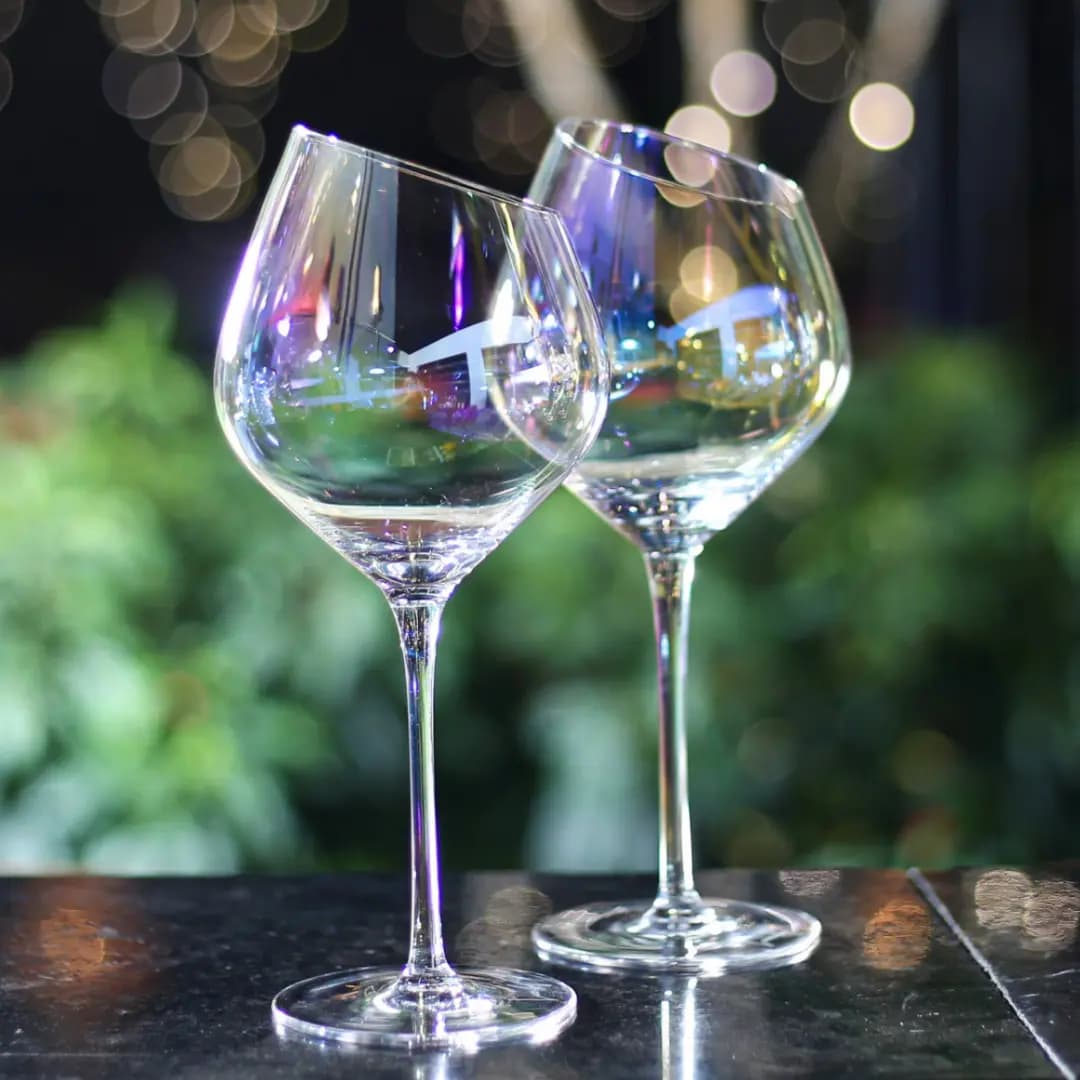
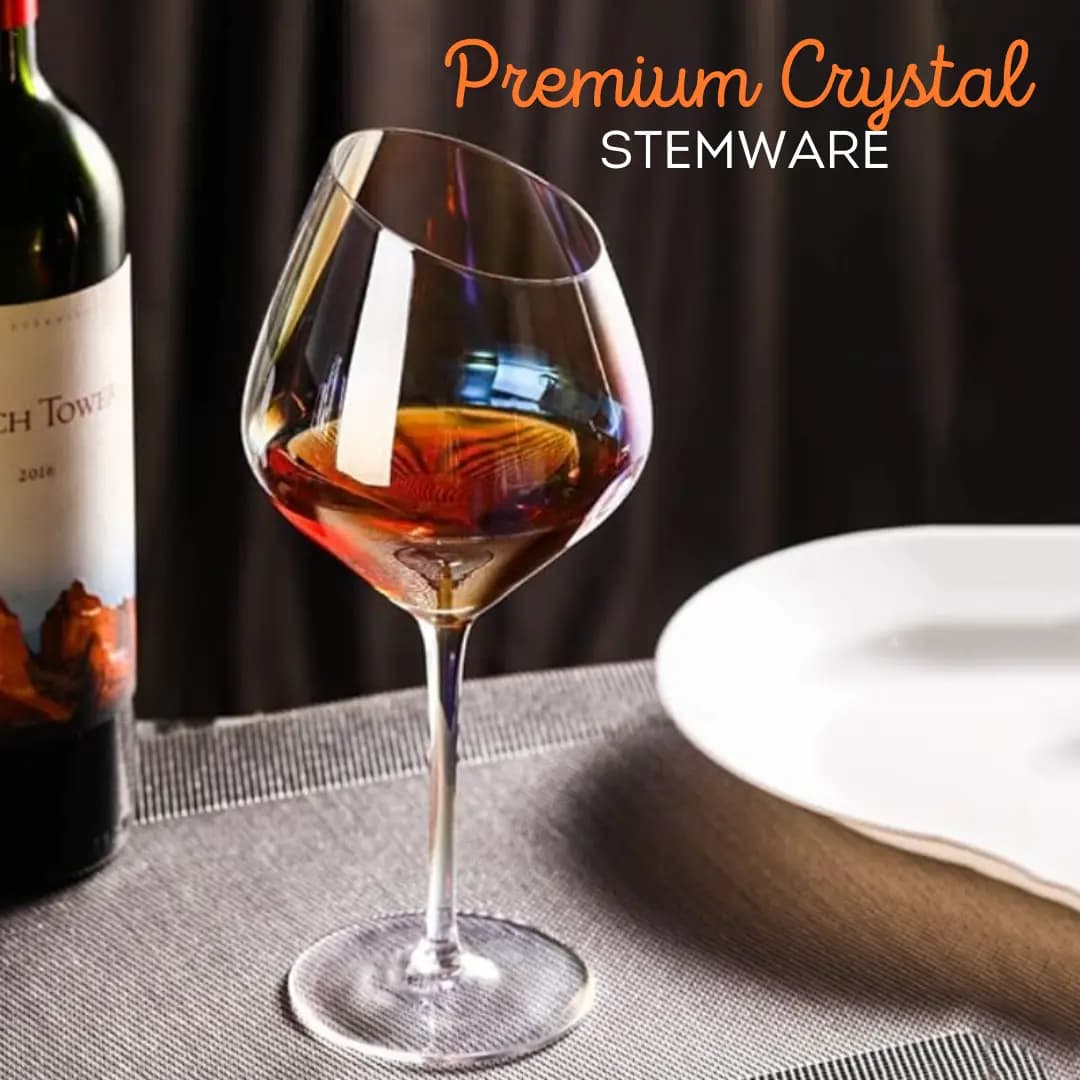
There is a particular pleasure in cupping a stemless wine glass — palm wrapped around the bowl, fingertips meeting at the curve, the wine warming a degree or two from the heat of your hand. Add an iridescent finish to that bowl and the simple act of holding a glass turns into a small piece of theatre. The pearled surface picks up every shift in light: the candle on the table, the lamp behind the sofa, the wash of sunset coming through the window. You set it down and it still glows.
Iridescent stemless wine glasses are one of the easier upgrades a household can make to a weekly wine ritual. They look modern, they survive dishwashers far better than their stemmed cousins, and the rainbow shimmer transforms even a mid-week glass of Pinot Grigio into something photogenic. But not every iridescent tumbler on the market is made the same way, and the difference between a $12 spray-coated novelty and a properly plated crystal piece is the difference between a glass that fades in six months and one you will be drinking from a decade from now.
Iridescent Stemless Wine Glasses at a Glance
These are the specifications that separate a lasting piece from a fading novelty, summarized from the full guide.
| Criteria | Recommendation |
|---|---|
| Material | Lead-free crystal, not soda-lime glass |
| Rim | Thin, laser cold-cut, under 2mm |
| Capacity | 14 to 18 fl oz, with 16 oz the sweet spot |
| Base | Genuinely flat so the glass will not rock |
| Finish | Vacuum ion-plated and confirmed by the brand; spray coatings fade |
| Dishwasher | Top-rack rated |
| Best uses | Rosé, chilled whites, lighter reds, spritzes, and table water |
What Makes Iridescent Stemless Wine Glasses Different
The "stemless" half of the equation is easy to understand: the bowl sits directly on a flat base instead of perching on a slim stem. The glass is shorter, more stable, and easier to wash. It feels less formal, which is partly why it has become the default in modern entertaining — you can hand someone a stemless glass at an outdoor cookout without anyone worrying about a wobble.
The "iridescent" half is where the craft happens. Iridescent stemless wine glasses are crystal tumblers finished with a microscopic metallic-oxide layer that splits incoming light into a moving rainbow. Move the glass and the colors slide across the surface — pearl one moment, lavender the next, a flash of green at the curve. The effect is achieved one of two ways. The cheap path is a sprayed-on tinted lacquer that sits on the surface like a film and tends to wear off. The right path is vacuum ion plating: the glass is loaded into a vacuum chamber where ionized metallic particles bond directly into the silica structure of the crystal. The color is not paint — it becomes part of the glass itself.
That bonding is why a properly made iridescent stemless wine glass can be tossed onto the top rack of a dishwasher every Sunday for years without the rainbow finish dulling. It is also why two glasses that look identical in product photos can perform very differently in real homes.
Why Stemless Iridescent Glasses Suit Modern Drinking
Stemmed wine glasses are still the right choice for a serious tasting or a formal dinner, where the stem keeps body heat away from the wine and lets the glass be swirled cleanly. But most of us are not drinking like that most of the time. Most of us are pouring a glass of rosé while making dinner, sharing a bottle on the couch with someone, taking a glass out to the patio, or refilling a friend's hand mid-conversation in a kitchen. Stemless glasses fit those rhythms better.
A few reasons iridescent stemless wine glasses, in particular, have become a default upgrade:
- They are dishwasher-friendly in a way stemmed crystal often isn't. The shorter profile means glasses do not topple, the lack of a delicate stem-to-bowl join means there is no fragile point to crack, and the wider base sits cleanly between rack tines.
- They are unintimidating. A long-stemmed crystal flute reads as formal. A pearl-finish stemless glass reads as inviting. People hold them more confidently and refill them more often.
- They double as cocktail glasses. Spritzes, Aperols, white sangrias, even a serious gin and tonic look right in a 12-to-16 oz iridescent stemless bowl. A flute would feel forced; a stemless wine glass does not.
- They photograph beautifully. If you cook, host, or simply share dinner photos with friends, the iridescent finish does the visual work that fresh flowers used to do — without any cost beyond the glass itself.
- They are a low-stakes way to try color. Plenty of buyers are curious about colored crystal but cautious about committing to a full set of iridescent stemmed glasses. A pair of stemless tumblers is the gentlest way in.
This is the same logic driving the broader colored crystal wine glasses trend. The interest in colored stemware is not really about novelty; it is about glassware doing more than just holding wine.
What to Look for in a Quality Stemless Iridescent Wine Glass
Iridescent stemless wine glasses do not all deserve the same shelf. Use this checklist when comparing options.
- Lead-free crystal, not soda-lime glass. Real crystal refracts light more brilliantly, rings on the rim, and feels lighter for its size. Soda-lime "glass" is duller and chips more easily.
- A thin, laser-cut rim. Stemless glasses are sometimes finished with thicker rolled rims because manufacturers assume "casual" means "less precise." The right ones still cold-cut the rim to under 2mm, which makes the wine flow over the lip cleanly.
- A capacity of 14 to 18 fl oz. Smaller than that and a generous pour fills it past the level where you can swirl. Larger and the glass loses the easy-handed feel that makes stemless worth buying.
- A genuinely flat base. A subtly concave or warped base will rock on a tabletop. Run your thumb under the base before you commit.
- Vacuum ion-plated finish, confirmed by the brand. This is the make-or-break specification. Spray coatings fade. Plating doesn't.
- Top-rack dishwasher rated. A stemless wine glass that has to be hand-washed loses most of its practical advantage.
If a glass clears all six points, you are looking at a piece that earns its place in the cabinet.
Stemmed or stemless — does the wine actually taste different?
This is the question I get most often. The honest answer is: not as much as the internet sometimes suggests. The bowl shape, rim thinness, and crystal quality matter far more to a wine's taste than whether or not it has a stem. A well-made stemless glass with a properly cut rim and a generous bowl will deliver a Pinot Noir or a Sancerre beautifully.
Where stemmed glasses do still win is body-heat management on long sips. Cup a stemless glass for thirty minutes with a chilled white inside and you will warm the wine a few degrees above the temperature you poured it at. For a casual dinner, that is fine. For a formal tasting where temperature is being controlled to the half-degree, a stemmed glass is the more disciplined choice. Most of us are not running a tasting on a Wednesday night. Most of us are sharing a bottle.
Pairing Iridescent Stemless Glasses to Wine Styles
A stemless glass with a 16-ounce bowl is one of the most versatile pieces in a household, but a few notes on pairings:
- Rosé and chilled whites. This is the natural fit. The stemless bowl is wide enough for the wine to express, and the iridescent finish picks up the pink, peach, and pale gold tones of the wine itself. Provençal rosé in particular looks unreasonably good.
- Lighter reds — Pinot Noir, Gamay, Beaujolais, Grenache. A 16-oz stemless bowl is sized closer to a Burgundy glass than a Bordeaux glass, which suits red wines built on perfume rather than tannin. Heavier Cabernet or Syrah is happier in a stemmed glass with more headroom.
- Spritzes and white sangrias. Iridescent stemless bowls were almost designed for an Aperol spritz. Add a slice of orange and the bowl looks like a sunset.
- Champagne and prosecco. Possible, but you sacrifice some of the carbonation that a tall flute preserves. For sparkling wine, an iridescent crystal champagne flute is the better-suited piece.
- Ice water at the table. Underrated. A pair of iridescent stemless glasses for water makes a dinner table look composed without any extra effort.
For a deeper dive on the underlying choice between formats, our stemless vs stemmed wine glasses guide walks through the trade-offs in detail.
How to Care for Iridescent Stemless Wine Glasses
Even durable, vacuum-plated iridescent stemless glasses last longer with a little care.
Rinse them with warm water shortly after use — not because tannins damage the finish, but because hard-water rings can dry into the bowl if it is left overnight with wine residue. For routine washing, the top rack of a residential dishwasher is fine, with glasses spaced so they cannot knock against each other and a low or air-dry heat cycle. If you hand-wash, use lukewarm water, a small amount of unscented detergent, and a soft microfiber cloth. Skip abrasive sponges, scouring pads, and citric-acid descalers; the iridescent layer does not need them.
Store stemless glasses upright on a flat shelf rather than inverted on the rim. Even though stemless glasses do not have a delicate stem to crack, the rim is still the thinnest part of the bowl, and resting it on the shelf invites micro-fractures over time. We have a longer guide on the topic in storing wine glasses, and on cleaning specifics in how to wash crystal glasses.
Frequently Asked Questions
Are iridescent stemless wine glasses dishwasher safe?
Yes — provided the iridescent finish is applied by vacuum ion plating rather than by spray coating. Properly plated iridescent stemless glasses can be washed on the top rack of a residential dishwasher repeatedly without the rainbow finish dulling. Spray-coated alternatives often fade after the first season of dishwasher use.
Do iridescent stemless wine glasses change the taste of wine?
No. The iridescent finish is purely on the outer surface of the bowl and does not contact the wine. What does affect the taste is the bowl shape, rim thinness, and crystal quality — all factors driven by craftsmanship, not color treatment.
How big should a stemless wine glass be?
For most households, 14 to 18 fluid ounces is the sweet spot. A 16-ounce bowl is generous enough to hold a proper pour with room to swirl, and small enough to feel comfortable in the hand. Smaller than 12 ounces and you cannot really swirl; larger than 20 and the glass starts to feel ungainly without a stem.
Are iridescent stemless wine glasses appropriate for formal dinner parties?
For most home dinner parties, yes — they read as deliberately modern rather than informal. For a strictly traditional table, or for a formal tasting where wine temperature is being closely controlled, a stemmed glass is still the more conventional choice. The two formats can be mixed: stemmed glasses for the wine, iridescent stemless tumblers for water or aperitifs.
Can iridescent stemless wine glasses be used for cocktails?
Yes. A 16-ounce iridescent stemless bowl is well-suited to spritzes, white sangrias, and long gin-based cocktails. The wider opening lets aromatics breathe, and the iridescent finish picks up the color of citrus and herbs beautifully. Avoid them for shaken cocktails served straight up — those still belong in a coupe or martini glass.
The Luxrify Take
We hand-blow every glass in our wine collection from lead-free crystal, finish each rim by laser cold-cutting to a near-invisible 1mm edge, and bond the iridescent and amber colors into the surface using vacuum ion plating — which is why we can promise the rainbow finish will not fade through years of dishwasher cycles. While our Iridescent Crystal Wine Glasses are stemmed by design, the bowl and rim are built on the same craft principles that make a great stemless pour. For households leaning more casual or more celebratory, the Iridescent Crystal Champagne Flutes bring the same iridescent finish to sparkling wine and Sunday mimosas.
If you are starting a collection of colored stemware and want to see the finish in person before committing to a full set, the smaller pour-set is the easiest entry point — built to be passed down rather than replaced.