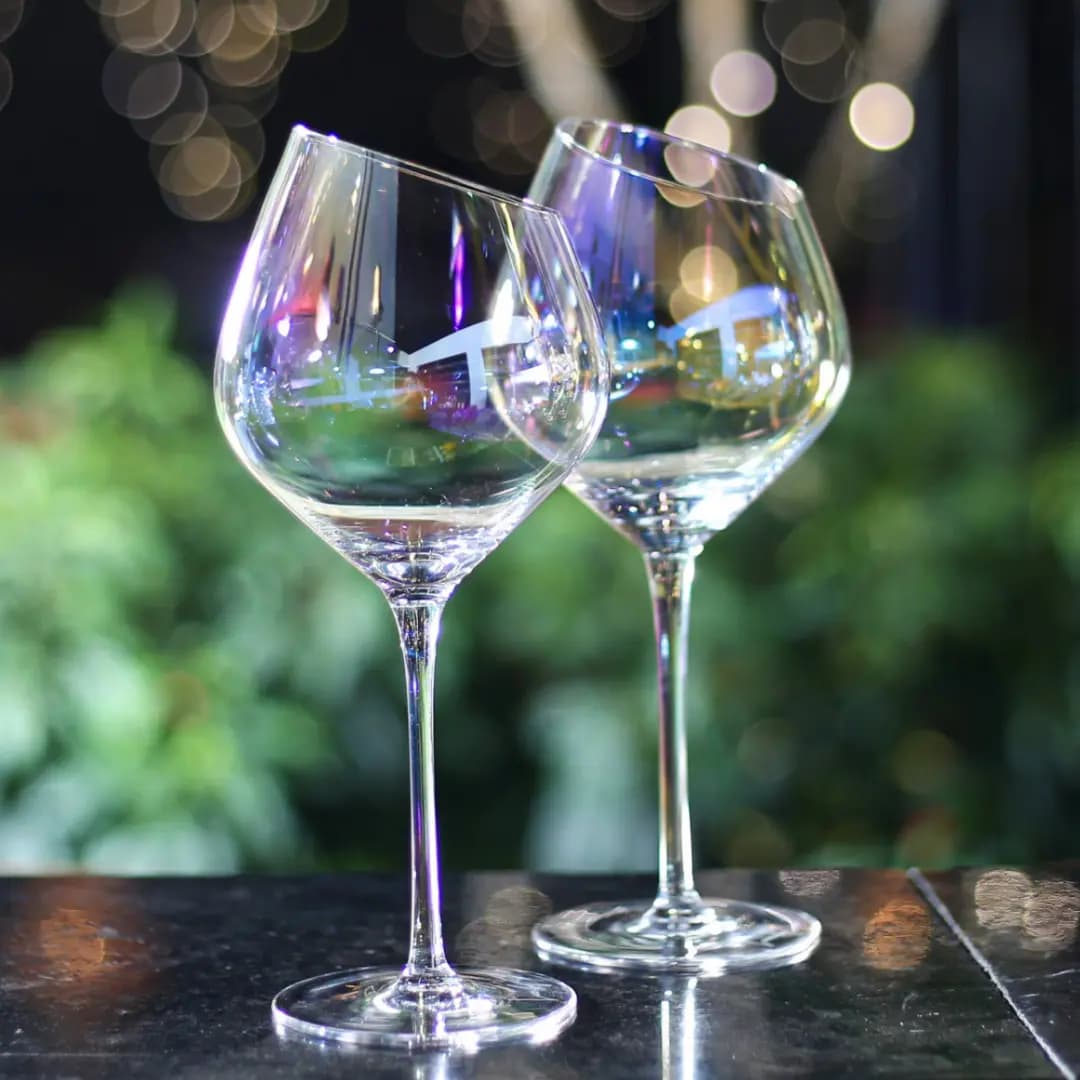
A few years ago, an iridescent glass on a dinner table would have read as a flourish — something a host pulled out for a birthday or a wedding-anniversary dinner. Now it is the dinner table. Open any new restaurant in Brooklyn or Lisbon, scroll any well-styled food account, walk into any homeware store with a curated buy, and iridescent glasses are everywhere: the wine pour, the water glass, the gold-light cocktail at the bar. The shimmer is the new neutral.
I have been styling tablescapes professionally for more than a decade, and I will admit the speed of this shift surprised me. Most tabletop trends arrive softly — a color of the year here, an accent stem there. Iridescent glassware did not arrive softly. It moved into rooms wholesale and stayed. This piece is for the reader who keeps seeing iridescent glasses and wants to understand why, where the trend actually came from, and how to bring it into a real home without a single piece feeling like a costume.
Why Are Iridescent Glasses Everywhere in 2026?
Here is the whole story in one view, before we unpack it.
| Aspect | What to Know |
|---|---|
| What it is | Glass finished by vacuum ion plating so the surface scatters light into a shifting rainbow -- structural color, not paint or dye |
| Why now | Social media rewards photogenic objects, plating made the finish durable for daily use, and tastes swung away from all-clear minimalism |
| Why it works | The color is the entire spectrum, so it reads as a soft neutral that flatters candlelight, natural materials, and metals |
| How to start | A pair of iridescent wine glasses first, flutes for the next celebration, serving pieces later |
| Styling rule | Maximum two iridescent pieces per place setting, with a calm table around them |
| Quality test | Light weight in hand, a glassy-smooth rim, and a brand that names vacuum ion plating as its finish |
What "Iridescent" Glassware Actually Means
Before getting into the trend, it helps to be precise about the term. Iridescent glassware is not painted, dyed, or tinted. It is glass treated so that its surface scatters light into a moving rainbow — the same physical principle that makes a soap bubble shimmer or the back of a CD throw color. The effect is structural rather than chromatic: there is no single "iridescent" hue, only a play of every hue, shifting with the angle.
The technique with the longest pedigree dates to the late nineteenth century, when Tiffany Studios and the Bohemian glassmakers began producing "favrile" and "lustre" pieces by exposing molten glass to metallic vapor. The modern, durable version of the same idea is vacuum ion plating: glass is loaded into a vacuum chamber, ionized metallic-oxide particles are accelerated onto its surface using an electric field, and the resulting layer bonds into the silica at a molecular level. The color does not sit on the glass like paint; it becomes part of the glass. This is the difference between iridescent glasses that hold up for decades and the spray-tinted novelty pieces that chip after a season.
That distinction is the single most useful filter when you start shopping. The shimmer is the easy part. The longevity is everything.
Where the Iridescent Glass Trend Actually Came From
The current wave is not the first iridescent moment. Tiffany favrile glass was a sensation in the 1900s. Carnival glass had a working-class boom in the 1920s, when American factories pressed iridescent bowls and pitchers as fairground prizes. By the 1970s, lustreware ceramics were a mainstay on bridal registries. The look returns in roughly thirty-year cycles because there is nothing else in the design vocabulary that does what it does — it is decorative without being thematic, colorful without being committed to a color, and luxurious without being cold.
What is different in 2026 is the convergence of three forces. First, social media reward photogenic objects, and iridescent glasses photograph the way nothing else does — they pull every available light into themselves and put on a small show. Second, advances in vacuum ion plating made the finish genuinely durable, which moved iridescent glasses out of the special-occasion cabinet and into everyday rotation. Third, after a long stretch of minimalist, all-white, all-clear interiors, the eye has gone hungry for warmth and color. Iridescent glasses provide both without committing the room to a palette.
The trend is also part of a broader shift toward colored crystal stemware and amber glassware, where the glass itself contributes to the look of the table rather than disappearing into it.
Why Iridescent Glasses Look So Right With Almost Anything
Most colored objects in a home are committed. A blue vase pulls the room toward blue. A green napkin pulls it toward green. Iridescent glassware does not do this. Because its color is the entire spectrum, it reads as a soft neutral that lifts whatever sits next to it.
A few specifics on how the optical effect actually works in real rooms:
- It mirrors candlelight beautifully. The warm spectrum of a flame reads through iridescent glass as gold, peach, and rose — exactly the colors that flatter food and skin.
- It echoes natural materials. Iridescent finishes share visual DNA with mother-of-pearl, opal, and seashell. Pair them with linen, raw wood, and ceramic and the table reads as organically composed.
- It reads as both modern and historical. The technique is centuries old and the specific aesthetic feels distinctly contemporary, so iridescent glasses fit a nineteenth-century apartment and a brand-new build with equal grace.
- It contrasts cleanly with metals. Brass, copper, and unlacquered silver flatware all sit beautifully against an iridescent bowl, where they would fight a heavily colored or patterned glass.
- It coordinates with itself. Mixing iridescent wine glasses, iridescent flutes, and iridescent water glasses on one table never reads as too much — because their color is light itself, the cumulative effect is harmony, not clamor.
This versatility is the practical reason the trend has stuck. Trends fade when the underlying piece is hard to use; iridescent glassware turns out to be one of the easiest objects to use in a styled room.
Five Ways to Bring Iridescent Glassware Into a Real Home
Trends fail in homes when they are imported wholesale from a magazine spread. The houses that do this well introduce one or two pieces, let them settle, and build out from there. Here is how I usually phase iridescent glassware into a client's table.
- Start with the wine glass. A pair of iridescent crystal wine glasses is the lowest-stakes entry. They get used most often, they justify themselves on flavor as well as looks, and they translate immediately to weeknight dinners.
- Add the flute for the next celebration. A set of iridescent crystal champagne flutes makes anniversaries, New Year's Eves, and impromptu Sunday mimosas feel deliberate. They are also the single best thing a couple can have on a wedding registry.
- Layer in pitchers and serving pieces slowly. A single iridescent water pitcher on a brass tray transforms a dinner table without requiring you to commit the rest of the glassware to the look.
- Introduce a mirrored or natural-stone surface. Iridescent glasses double their effect when set on a surface that reflects light back — a polished marble cheese board, a brass charger, a sheet of glass over linen.
- Edit the rest of the table. This is the secret most people miss. Iridescent glassware does its best work when the table around it is calm — bare wood, white linen, simple silverware, a low arrangement of greenery rather than busy florals.
For tabletop ideas that work alongside iridescent stemware year-round, our tablescape ideas guide maps out seasonal pairings in detail.
One mistake to avoid
The instinct, when something is striking, is to load up. Resist it. A table of twelve identical iridescent place settings — flute, wine, water, salad plate — slips out of "modern" and into "themed." Two iridescent pieces per setting is the right ceiling. Mix in plain crystal water glasses, simple flatware, and unfussy plates, and the iridescent pieces stay the focal point rather than the wallpaper.
Iridescent Glasses for Different Occasions
Where iridescent glassware truly shines depends partly on what kind of host you are.
For weeknight dinners, iridescent wine glasses and water tumblers do the job alone. The dinner-photograph upgrade is immediate, the maintenance is no different from any other crystal, and the glasses survive the dishwasher. For weekend dinner parties, add iridescent flutes and a single iridescent decanter or pitcher; the glassware now does the styling that fresh flowers used to. For weddings and milestone events, iridescent flutes are a registry mainstay precisely because they feel celebratory without locking the couple into a particular color story for the rest of their life. For gift-giving, iridescent stemware is one of the few presents that feels both luxurious and broadly safe — the recipient cannot have the wrong taste in iridescent because the color is, by definition, every color.
For wedding glass selection specifically, our best champagne glasses for weddings post pairs nicely with this trend overview.
How to Tell Quality Iridescent Glassware From Costume
The trend has, predictably, attracted a lot of low-cost imitators. Three quick tests separate the real piece from the costume.
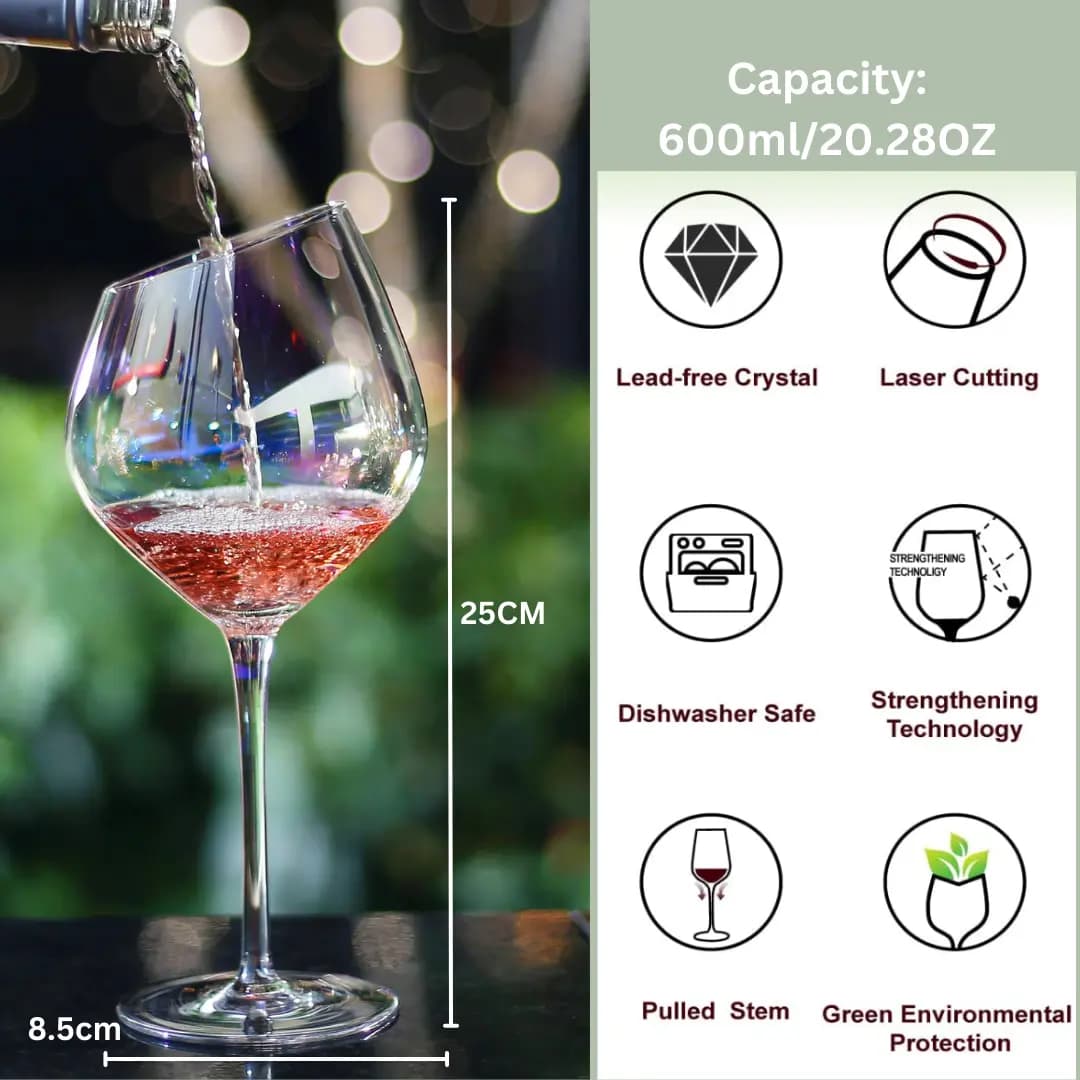
The first is weight in hand. A real iridescent crystal glass made by hand-blowing has thin walls and a balanced, almost weightless feel. A spray-coated soda-lime glass feels chunky and bottom-heavy. The second is the rim. Run your fingertip along the lip. A laser-cut or polished rim is glassy-smooth and barely registers; a rolled or pressed rim feels like a small step at your lip. The third is the brand's own answer to the question "how is the iridescent finish applied?" If the marketing copy talks about vacuum ion plating, you are in the right place. If the answer is vague, the finish is probably sprayed.
A glass that passes all three tests will still be on your shelf — and still looking new — long after the next trend has cycled through.
Frequently Asked Questions
Are iridescent glasses a trend that will date quickly?
Iridescent glassware sits in roughly thirty-year cycles — favrile in the 1900s, carnival glass in the 1920s, lustreware in the 1970s, and the current wave starting around 2020. Because the look is structural rather than tied to a particular color, it ages more gracefully than most tabletop trends. A well-made iridescent piece will look intentional in any decade.
Will iridescent glassware look dated in five years?
Properly plated iridescent crystal does not visually date the way printed china or shaped fashion glass does. The optical effect is timeless because it is, in essence, a play of light. What dates a glass is poor craftsmanship — chunky proportions, peeling coatings, dull finishes — not the iridescent effect itself.
Is iridescent glassware safe to drink from?
Yes. Iridescent glassware made from lead-free crystal with a vacuum ion-plated finish is fully food-safe. The metallic-oxide layer is bonded into the surface and does not leach. Avoid older or vintage iridescent pieces of unknown provenance, which may contain lead or use legacy coatings not intended for direct food contact.
Can iridescent glasses go in the dishwasher?
Quality iridescent glasses with vacuum ion-plated finishes are dishwasher safe on the top rack at low to medium heat. Spray-coated iridescent glasses, often sold at lower price points, are typically not dishwasher safe and can fade or peel after repeated wash cycles. Always check how the finish is applied before committing.
How do I style iridescent glassware without it looking too much?
Limit yourself to two iridescent pieces per place setting and keep the rest of the table calm — plain white linen, simple flatware, neutral plates. Set the glasses on a surface that reflects light back, like marble or brass. The iridescent finish does its best work when it has room to breathe.
The Luxrify Take
The iridescent glasses trend earns its longevity only when the underlying glass is real. We hand-blow every piece in our collection from lead-free crystal, laser cold-cut every rim to a near-invisible edge, and bond the iridescent finish into the glass through vacuum ion plating — the reason we can promise the color will not fade through years of regular dishwasher cycles. The slanted rim was designed to channel aromas toward the nose as you sip, so the glass works on flavor as well as light.
For most households, the Iridescent Crystal Wine Glasses are the right place to start, and the Iridescent Crystal Champagne Flutes are the right second piece. Both are dishwasher safe, both ship free in the US over $100, and both are built to be passed down rather than replaced.